Microeconomics

3.0 Supply

3.1 Definitions

a) The Firm
    a technical unit engaged in the production of one or a group of related commodities. In theory, perceived as a single product firm with the entrepreneur serving as a surrogate for a decision-making hierarchy and involving the study mainly of external behavior and only ‘cost analysis’ of internal production decisions, i.e. not study of business management.

b) Profits
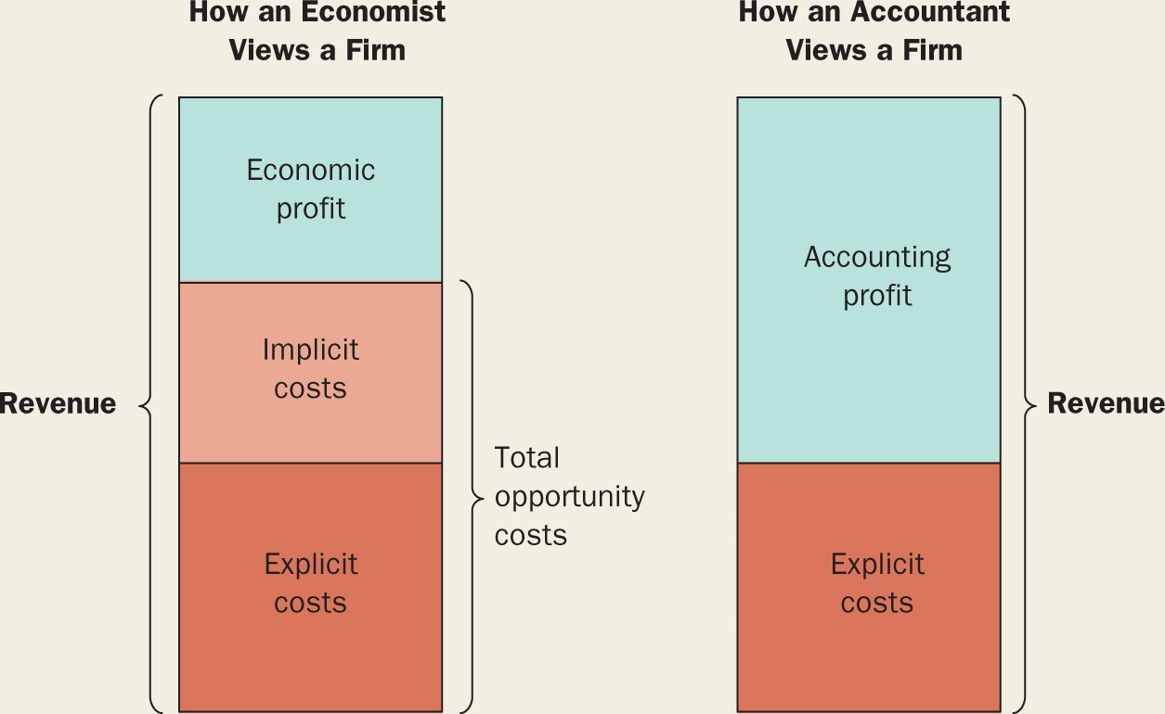
    the residual of revenue (price times quantity sold) after all factors of production have been fully compensated.  It is compensation for uncertainty and entrepreneurship (normal or competitive profits) or for monopoly (excess profits) or windfalls, i.e. there are different forms of profit.  In theory, profit is viewed as raison d’etre of the firm which can be achieved, however, only by satisfying consumer wants.  A strictly economic approach is assumed, i.e. political and social questions not considered.  
    A distinction must be made, however, between 'normal' profits defined as the opportunity cost of entrepreneurship and 'economic' profits which is the excess of profits earned above normal profits.
  (MBB 10th Ed. Fig. 7.1; MBB 11th Ed. Fig. 6.1; P&B not displayed)

c) Production
    the creation of goods and/or services, which, directly or indirectly, satisfy human needs.  Through production the firm generates supply which is the obverse of consumer demand.  In theory, production is viewed as the only function of the firm.  Through supplying commodities demanded by consumers, the firm maximizes profits.

d) Input (or Factors of Production)

any good or service which contributes to the production of output. In theory, factors include: capital (K); labor (L); land (N); and entrepreneurship. This last factor is poorly defined and resists empirical measurement.  In fact there are three forms of Labour - (i) Productive, (ii) Managerial & (iii) Entrepreneurial.


(i) Productive

Productive workers are those on the shop floor actually producing goods & services. They are concerned with output. Their knowledge is technical and specialized to a given industry or firm. In effect they combine codified and tooled with personal & tacit knowledge (memory and reflex) generally learned on the job in the Anglosphere. Their knowledge involves making something or making something work. In this sense the competitiveness of a firm or nation “depends not only on sensible decisions about what to do, but on the availability of the skills that are required to do it” (Loasby 1998, 143).


(ii) Managerial

Management, among other things, means “a governing body of an organization or business, regarded collectively; the group of employees which administers and controls a business or industry, as opposed to the labour force”. It also means “the group of people who run a theatre, concert hall, club, etc” (OED, management, n, 6). The role of management is to make available the means (inputs) so that production workers can perform their tasks and then to market and distribute the output. In many ways management is like a choreographer, music or theatre director. This sense of modern management is caught by Aldrich:

Thus the total operation is a performing art with blueprints for score or choreography, the difference being that in this technological case neither the co-ordinated performances (ballet) of the skilled workers nor the finished product is put on exhibit simply to be looked at, contemplated. It is a useful performing art. Its value is instrumental.” (Aldrich 1969, 381-382)

Similarly, according to Schlicht, it is:

the fit of the organizational elements, rather than the elements themselves, that characterizes a firm. Just as the quality of an orchestra performance cannot be adequately measured by the average quality of the performances achieved by the individual instruments, but depends crucially on the way the instruments are played together, so the productive value of a firm - as opposed to a set of individual contracting relationships - emerges from the quality that has been achieved through mutually adjusting the various activities that are carried on. (Schlicht 1998, 208)

One crucial characteristic of the firm is custom including tacit understandings of entitlements and obligations between productive, managerial and entrepreneurial workers. This constitutes part of what is commonly called ‘the corporate culture’ for which, on a day-to-day.


(iii) Entrepreneurial

With the notable exception of firms like Microsoft (Bill Gates) and Walmart (Sam Walton), most modern corporations do not follow an original founder/owner but rather a ‘hired gun’, or business entrepreneur.  The word ‘entrepreneur’ comes from the French entre meaning ‘between’ and prendre meaning ‘to take’.  The English ‘middleman’ retains this original sense.  During the Middle Ages and Renaissance, European traders (especially from Venice and Genoa) ‘middled’, at high risk, between foreign suppliers, e.g. of silk and spices from the Turks, and final consumers in northern Europe.  Today the term usually refers to someone who sees and seizes an economic opportunity or a market opening or gap.  This may take the form of a new product or of servicing an existing market in a new way.  In both cases a high degree of creativity and risk-taking is implicit.  In this regard, the first English usage of ‘entrepreneur’ was in 1828 meaning “the director or manager of a public musical institution.”  Today we would call this ‘an impresario’.  In fact, it was not until 1852 that entrepreneur took its modern meaning of “one who undertakes an enterprise; one who owns and manages a business; a person who takes the risk of profit or loss (OED, entrepreneur, a, b). 

Entrepreneurial knowledge is intuitive in seeing and taking advantage of invariants and affordances in a market that others do not see.  It involves seeing and realizing a vision of future markets, products and opportunities.  Ignorance is the opposite of knowledge, i.e., want of knowledge.  The non-rational way of entrepreneurial vision was called ‘animal spirits’ by Keynes (Keynes 1936, 161).  Like some ancient priest-king, the entrepreneur ‘knows’ the future and leads his people (investors, managers, workers and consumers) into it – right or wrong - to success or failure.  In a manner of speaking, prophets today seek profits, not souls.  Ideally, this highly valued form of pattern recognition works best as “informed intuition” (Jantsch 1975).  All available information, knowledge and opinion is explicated but then an intuitive, inductive judgmental vision is conjured up.  In a sense, the business entrepreneur or CEO has assumed the mantle of the Western Cult of the Genius joining the artist, inventor and scientist. 

e) Output
    the result of transforming inputs into goods or services, which satisfy, directly or indirectly, human needs.  In theory, quantity of output, along with price and cost is key in the economic equation.  Output is increased until any additional output reduces profits.

f)  Ownership vs. Control
    a firm may be owned and controlled by the same individual or group, or these two functions may be separated.  In theory, it is assumed there is no significant effect of their separation and profit maximization remains the functional objective of the firm.

g) Diversification 
    the distribution of productive investment across geographic space, or multiplying the number and types of outputs in order to insure profit stability by offsetting gains and losses.  In theory, geographic diversification is not formally considered except as additions to factor cost.  Similarly multiple outputs not formally considered.

h) Cost
   
the value of factors of production in producing output and serves, along with price and quantity of output, as key factor in economic decision-making.  If profit equals price time quantity of output (revenue) less total cost the total cost equals the cost of input x plus the cost of input y.

i)  Profit Maximization
    the rational entrepreneur tries to maximize profits.  In theory, profits are expressed in $'s and assumes no other objective is compatible with rationality.  Profit maximization insures survival of the firm.

to Micro 3.2