|
5.1 Fiscal Policy:
Tax & Spend (MKM C15/391-413:
366-87;
C16/ 384-403;
361-379)
While the Great
Depression of the 1930s was the most severe and long lasting, it was but a
single link a long chain of business cycle boom/busts dating back to the
beginning of the Industrial Revolution. Until the Keynesian Revolution of
1936 Government played little if any role in managing the national economy.
Rather the business cycle was allowed to run its course according to the 'iron
law of wages'. In the boom, labour becames scarce and wages rose. In
the bust, labour was increasingly unemployed. Wages fell until low enough
for firms to re-hire beginning the upswing of the business cycle. Meanwhile
workers became increasingly desperate in the downturn. There was no social
safety net like unemployment insurance, welfare or medicare.
The
Keynesian Revolution established that Government should spend in bad and save in
good days. It also dictated Government's reaction to the business cycle should
be both automatic as well as discretionary. In this new architecture of public
finance, automatic stabilizers are triggered by 'objective' changes in the
economy and implemented automatically according to an existing Act of
Parliament, e.g., if unemployment rises, employment insurance payments increase. Discretionary fiscal policy action, on the other hand, requires debate in
Parliament of proposed legislation to mandate a new fiscal policy initiative,
e.g., changes in the income tax rate or increases in defense or other public
spending. Such discretionary action is justified if and only if automatic
stabilizers fail or are thought to fail to moderate the business cycle. This
'moderating the business cycle' is called 'counter-cyclical fiscal policy'.
If
the boom rises to fast, slow it down; if the bust falls too fast, slow it down.
A primary goal of fiscal policy, in the Keynesian sense, is to moderate the business cycle, to stabilize the economy. And linked to
moderating the business cycle is to do so while, at the same time, fostering growth
in potential GDP.
Keynes provided a tool to allow Government to stabilize the business cycle
without having to do it all itself. It is 'the multiplier'. He also spawned a
generation of economists who searched for new tools to foster growth in
potential GDP, i.e., how to make the economy grow. Growth theory is now a
recognized sub-discipline of the economics profession. The alleged failure of Keynesian economics between the 1960s and
1990s in fact represented Government choosing to spend on the upside as well as
the downside of the business cycle. This partially reflected 'policy lags',
i.e., recognize a problem, fashion a solution, implement it and wait for
the desired results. In other words, the impact of some Government
programs were simply out of phase with the business cycle. However, the
'guns & butter' policy of the American Government during the Vietnam War,
i.e., no special taxes were levied to pay for the war, meant Government
borrowed on the financial markets and increased the national debt. A
similar guns & butter policy also characterized the second 2003 Gulf War.
Arguably, it was not Keynesian policy but politics that failed.
For those interested in the political actors involved in fiscal
policy, please see:
Observation #5: Economics of Democracy.
For those interested the budgetary process, please see:
Observation #6: Fiscal Policy in Canada.
i - Assets,
Liabilities, Revenue & Expenditures
CSGFMS
ASSETS & LIABILITIES
|
Assets
|
Liabilities
|
|
1.
Cash on Hand & Deposits
|
1.
Borrowings from Financial Institutions
|
|
2.
Receivables
|
2.
Payables
|
|
3.
Loans & Advances to
|
3.
Loans & Advances from
|
|
4.
Investments
|
4.
Savings Bonds, Treasury Bills & Other Short-Term
|
|
5.
Other Financial Assets
|
5.
Bonds, Debentures & Treasury Bills – Long-Term
|
|
|
6.
Pension Plans, Deposit & Other Liabilities
|
|
|
Excess of
Financial Assets over Liabilities |
|
|
|
REVENUE
|
Taxes |
|
|
1.
Personal Income Taxes
|
14.
Succession Duties & Estate Taxes
|
|
2.
Payroll Taxes
|
15.
Gift Taxes
|
|
3.
Corporation Income Tax
|
16.
Health Insurance Premiums
|
|
4.
Taxes on Insurance Premiums
|
17.
Social Insurance Levies
|
|
5.
Other Taxes on Corporations & Businesses
|
18.
Universal Pension Plan Levies
|
|
6.
Taxes on Certain Payments & Credits to Non-Residents
|
19.
Other Taxes
|
|
7.
Real & Personal Property Taxes
|
Non-Taxes |
|
8.
General Sales Taxes
|
20.
Natural Resource Revenues
|
|
9.
Motor Fuel Taxes
|
21.
Privileges, Licences & Permits
|
|
10. Alcoholic
Beverages Taxes
|
22.Sales of
Goods & Services
|
|
11.
Tobacco Taxes
|
23.
Return on Investments
|
|
12.
Taxes on Amusements & Admissions
|
24.
Other Revenues from Own Sources
|
|
13.
Taxes on Other Commodities & Services
|
25.
Miscellaneous
|
EXPENDITURE
|
1.
General Government
|
11.
Labour, Employment & Immigration
|
|
2.
Protection of Persons & Property
|
12.
Housing
|
|
3. Transportation & Communications
|
13. Foreign Affairs & International Assistance
|
|
4. Health
|
14. Supervision and Development of Regions &
Localities
|
|
5. Social Welfare
|
15. Research Establishments
|
|
6. Education
|
16. General Purpose Transfers to Other Levels of
Government
|
|
7. Environment
|
17. Transfers to Own Enterprises
|
|
8. Natural Resources
|
18. Debt Charges
|
|
9. Agriculture, Trade and Industry, and Tourism
|
19. Other
|
|
10. Recreation & Culture
|
|
ii -Fiscal Policy Multipliers
But
how can discretionary fiscal policy
lever change the macroeconomy - assuming potential GDP is fixed.
After the budget debate about how much pleasure and pain, the composite total
(not allowing for 'distributional' effects) of tax and spend results in an
increase, a decrease or no change in autonomous aggregate expenditure. An
increase or decrease will change aggregate expenditure more than the initial
change via three fiscal policy multipliers assuming the short-run and
a constant price level. These are:
a) Autonomous/Government Expenditure Multiplier
b) Autonomous Tax Multiplier
c) Balanced Budget Multiplier
d) Impact of the Marginal Propensity to Import (MPM)
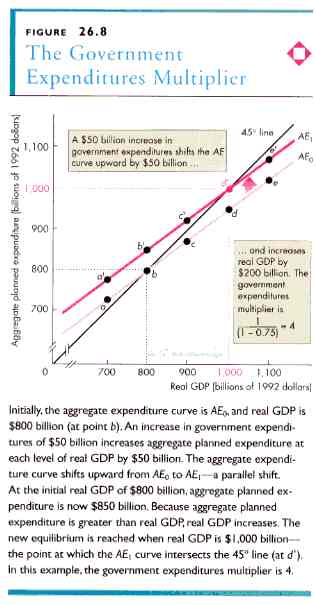
a) Autonomous/Government Expenditure Multiplier (GEM)
The GEM depends on the marginal
propensity to consumer (P&B 4th Ed
Fig. 26.8;
MKM Fig. 15.8). The higher MPC, i.e., the steeper the slope of the aggregate expenditure curve (AEC), the
greater GEM. The lower MPC, the gentler the slope of the AEC, the lower
GEM. MPC, however, is assumed to be constant. GEM = 1/1-b =
∆Y/∆G.
Say the MPC is .75 then Gem is 1/1-.75 = 1/.25 = 4. The same multiplier
applies to any autonomous expenditure change, e.g., exports and
investment. The impact of GEM is, however, also affected by the slope of
the Aggregate Supply Curve. If AS is elastic GEM will be large; if AS is
inelastic, small. This is a matter of professional controversy in
economics.
b) Autonomous
Tax Multiplier (ATM)
There are essentially two kinds
of taxes - induced and autonomous. Induced taxes rise and fall as real GDP
varies. The change in tax revenue is determined by the 'fixed' marginal tax rate
(MRT). Taxes increase or decrease as real GDP changes. In this way they
act as an automatic stabilizer,. i.e., if GDP grows then taxes increase
and transfer payments decline; if GDP declines then taxes fall and transfer
payments increase.
Autonomous taxes do not vary with
real GDP rather they are fixed by Government. An increase in taxes decreases
disposable income and hence consumption and therefore aggregate expenditure.
But the decrease in AE will be greater than the increase in taxes (P&B 4th
Ed
Fig. 26.9). The size of the ATM depends on the slope of the AEC
and, hence, of the MPC. ATM = -b/1-b =
∆Y/∆T.
If MPC is .75 then ATM is .75/1-.75 = 3 compared to 4 for GEM. This means
that a tax change has a smaller multiplier impact than an autonomous expenditure
change of the same nominal amount. This is because all of an autonomus
expenditure is spent immediately while a decrease in autonomous taxes is only
partially spent and partially saved (MPS).
The inverse of the ATM is the multiplier associated with transfers. Transfers
are like negative taxes, i.e. taxes are reduced. Another related concept is 'tax
expenditures' where Government selectively reduces taxes and losses revenue
thereby. The autonomous transfer multiplier is simply the negative of the ATM.
c) Balanced
Budget Multiplier (BBM)
The BBM is the amount by which a
simultaneous and equal change in government expenditures is matched by a change
in autonomous taxes. The result is that the initial balance between government
revenue and expenditure (deficit/surplus) is maintained. The BBM requires that the
effect of GEM
(1/1-b) should exactly offset the effect of ATM (-b/1-b) so that ∆Y/∆G
= - ∆Y/∆T
d)
Impact of Marginal Propensity to Imports (MPM)
If we assume a MPC of .75, i.e., 75 cents of every dollar is spent on
consumption then the GEM is 1/1-.75 = 1/.25 = 4. If, however, the MPM is
.1, i.e., 10 cents on every dollar is spent on imported goods then GEM is
1/1-.75-.1 = 1/.65 = 2.86. This compares with a closed economy GEM of 4.
e) Automatic Stabilizers vs. Discretionary Changes
(MKM
C15/406-8; 381-82; 400-401)
The Keynesian model does not rely only on discretionary fiscal
policy. As noted in the
introduction
to this section, discretionary policy can suffer from 'policy lags' leading to
counterintuitive effects, e.g., fiscal stimulus is implemented but its
impact occurs to late just as the business cycle turns around and then over
stimulates the upswing. On the other hand, automatic
stabilizers are triggered by 'objective' changes in the economy and implemented
automatically according to an existing legislation, e.g., in a downturn,
unemployment rises, employment insurance payments increase maintaining aggregate
demand and on the upswing payments into the unemp0loyment insurance fund
increase while outflows diminish. Similarly in a downturn causes income to
fall and marginal taxes decrease. Welfare and other public programs
automatically kick in during a downturn and decline in the upswing. A
flexible exchange rate similarly buffers domestic aggregate demand. During
the upswing of the business cycle Canadian prices, especially interest rates,
start to rise. Rising interest rate attracts foreign investment that
requires the purchase of Canadian currency increasing the foreign exchange rate.
Canadian exports become more expensive on world markets reducing exports and
thereby reducing aggregate demand. On the other hand, during a down turn
Canadian interest rates tend to fall and foreign investment declines as does
foreign demand for the Canadian currency thereby reducing the foreign exchange
rate. This makes Canadian exports less expensive and they increase thereby
boosting domestic aggregate demand.
iii - Short
& Long Run Fiscal Policy
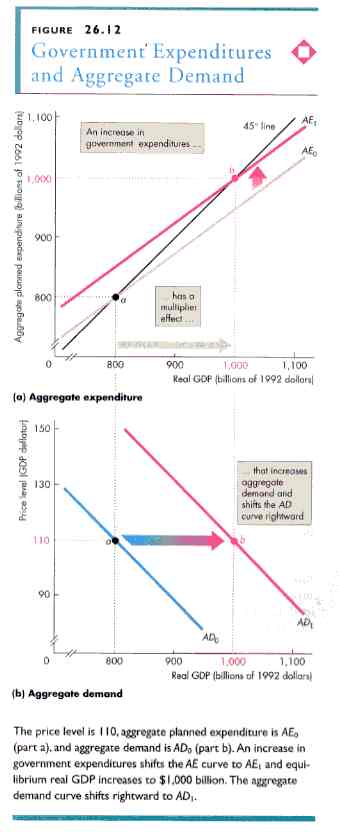
a) Aggregate Demand
Assuming price stability, an
expansionary fiscal policy (an increase in government expenditure, an increase
in transfers or a decrease in taxes) will push aggregate planned expenditure up
by the change times the appropriate multiplier. This will lead to an increase in
aggregate demand at the same price level and reflected in a shift to the right
of the aggregate demand curve (P&B 4th Ed
Fig. 26.12). Similarly, assuming price
stability a contractionary fiscal policy involves a decrease in government
expenditure, a decrease in transfers and/or an increase in taxes. This will lead
to a decrease in aggregate demand at the same price level times the appropriate
multiplier and reflected in a leftward shift of the aggregate demand curve.
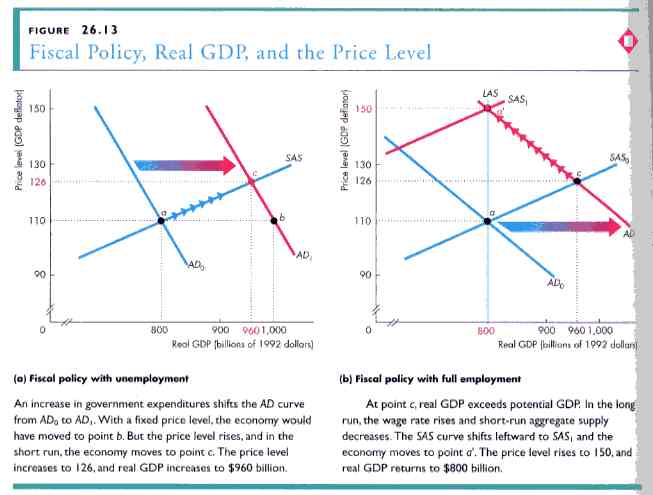
b) At or Below
Potential GDP
If the economy is below potential
GDP then there is some unemployment. The rightward shift of the ADC will,
however, intersect the ASC at a higher point. Thus some of the initial increase
in AD will inevitably translate into a general price rise reducing the overall
effect of an expansionary fiscal policy (P&B 4th Ed
Fig. 26. 13). If the economy is
at potential then all the effects of an expansionary fiscal policy must fail in
that there is no increase in real GDP possible and the only change has been an
increase in the price level.
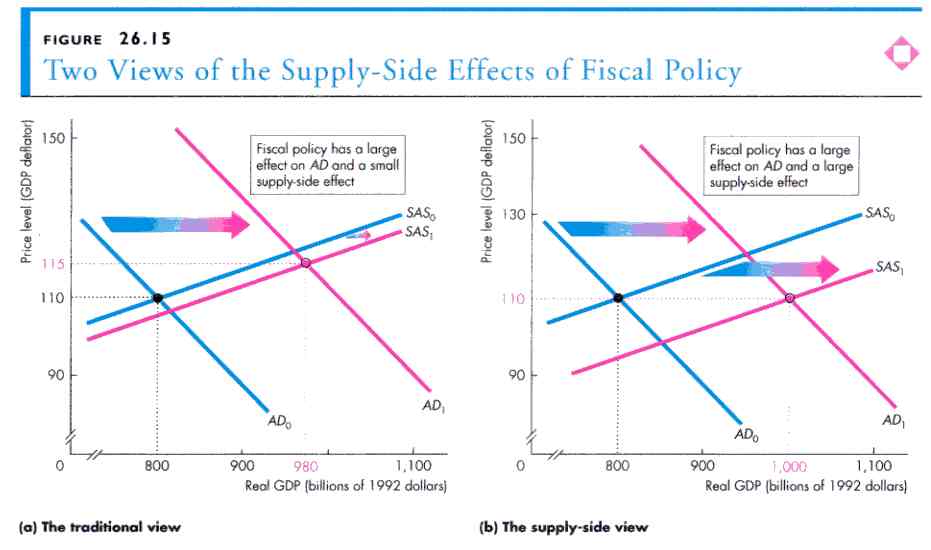
c) Aggregate Supply
While traditionally Keynesian theory
has focused almost exclusively on aggregate demand as a means of moderating the
business cycle and foster economic growth and price stability, a logical
extension leads to the supply-side. Taxes are treated as part of the price of
factors of production by firms. Accordingly, if taxes rise the cost of
production goes up and the ASC shifts to the left. Similarly, if taxes fall then
the ASC will shift to the right, in effect increasing potential GDP (P&B 4th
Ed
Fig. 26.15). Thus taxes have an effect on both AD and AS.
This is known as 'supply-side economics'. While tax reductions may have a
supply effect the fact is once taxes effectively reach zero this policy tools
loses any effectiveness.
d) Deficit & Debt
-
more like business
- balance sheet
- capital/operating and amortization
- trans-generational transfers
|