SITE INDEX
Dissertation
Bibliography
SISTER SITES
Compleat World Copyright Website
World Cultural Intelligence Network
Dr. Harry Hillman Chartrand, PhD
©
Cultural Economist & Publisher
Compiler Press
Chief Economist
Cultural Econometrics
h.h.chartrand@compilerpress.ca
215 Lake Crescent
Saskatoon, Saskatchewan
Canada, S7H 3A1
Tele/Fax
306-244-6945
Launched January 2002
The Competitiveness of Nations
in a Global Knowledge-Based Economy
October 2002
Extracts* from
THE JUNG LEXICON
derived from
Jung Lexicon: A Primer of Terms & Concepts
Daryl Sharp © 1991
Online: http://www.cgjungpage.org/jplexicon.html
Hardcopy: Inner City Books
Active imagination; Adaptation; Affect; Amplification; Analysis, Jungian; Anima; Animus; Anthropos; Apperception; Archetype; Archetypal image; Assimilation; Autonomous; Auxiliary function; Axiom of Maria; Circumambulation; Collective; Collective unconscious; Compensation; Complex; Conflict; Coniunctio; Consciousness; Constellate; Differentiation; Dreams; Ego; Emotion; Empathy; Extraversion; Eros; Fantasy; Feeling; Function; Individual; Individualism; Individuality; Individuation; Inferior function; Inflation; Instinct; Introjection; Introspection; Introversion; Intuition, Irrational; Libido; Logos; Myth; Neurosis; Numinous; Opposites; Participation mystique; Persona, Personal unconsciousness; Personality; Personification; Philosopher’s stone; Possession; Primary function; Projection; Psyche; Psychoid; Psychological types; Psychosis; Quaternarity; Rational; Reductive; Reflection; Regression; Religious attitude; Repression; Self; Self-regulation of the psyche; Sensation; Shadow; Soul; Spirit; Superior function; Symbol; Synchronicity; Tertium non datur, Thinking; Transcendent function; Treasure hard to attain; Type; Typology; Unconscious; Unconsciousness; Wholeness; Will; Wise old man.
Active imagination. A method of assimilating unconscious contents (dreams, fantasies, etc.) through some form of self-expression. (See also transcendent function.)
Adaptation. The process of coming to terms with the external world, on the one hand, and with one's own unique psychological characteristics on the other. (See also neurosis.)
Affect. Emotional reactions marked by physical symptoms and disturbances in thinking. (See also complex and feeling.)
Amplification. A method of association based on the comparative study of mythology, religion and fairy tales, used in the interpretation of images in dreams and drawings.
Analysis, Jungian. A form of therapy specializing in neurosis, aimed at bringing unconscious contents to consciousness; also called analytic therapy, based on the school of thought developed by C.G. Jung called analytical (or complex) psychology.
Anima. The inner feminine side of a man. (See also animus, Eros, Logos and soul-image.)
Animus. The inner masculine side of a woman. (See also anima, Eros, Logos and soul-image.)
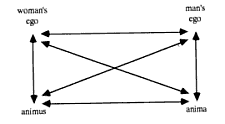
Anthropos. Original or primordial man, an archetypal image of wholeness in alchemy, religion and Gnostic philosophy.
Apperception. A psychic process by which a new conscious content is articulated with similar, already existing contents in such a way that it is understood. (Compare assimilation.)
Archetype. Primordial, structural elements of the human psyche. (See also archetypal image and instinct.)
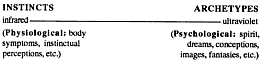
Archetypal image. The form or representation of an archetype in consciousness. (See also collective unconscious.)
Assimilation. The process of integrating outer objects (persons, things, ideas, values) and unconscious contents into consciousness.
Autonomous. Independent of the conscious will, associated in general with the nature of the unconscious and in particular with activated complexes.
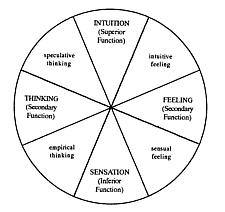
Auxiliary function. A helpful second or third function, according to Jung's model of typology, that has a co-determining influence on consciousness.
Axiom of Maria. A precept in alchemy: "One becomes two, two becomes three, and out of the third comes the one as the fourth."
Jung used the axiom of Maria as a metaphor for the whole process of individuation. One is the original state of unconscious wholeness; two signifies the conflict between opposites; three points to a potential resolution; the third is the transcendent function; and the one as the fourth is a transformed state of consciousness, relatively whole and at peace.
Circumambulation. A term used to describe the interpretation of an image by reflecting on it from different points of view. Circumambulation differs from free association in that it is circular, not linear. Where free association leads away from the original image, circumambulation stays close to it.
Collective. Psychic contents that belong not to one individual but to a society, a people or the human race in general. (See also collective unconscious, individuation and persona.)
Collective unconscious. A structural layer of the human psyche containing inherited elements, distinct from the personal unconscious. (See also archetype and archetypal image.)
The collective unconscious contains the whole spiritual heritage of mankind's evolution, born anew in the brain structure of every individual.[The Structure of the Psyche," CW 8, par. 342.]
Compensation. A natural process aimed at establishing or maintaining balance within the psyche. (See also active imagination, dreams, neurosis and self-regulation of the psyche.)
Complex. An emotionally charged group of ideas or images. (See also Word Association Experiment.)
Conflict. A state of indecision, accompanied by inner tension. (See also opposites and transcendent function.)
Coniunctio. Literally, “conjunction,” used in alchemy to refer to chemical combinations; psychologically, it points to the union of opposites and the birth of new possibilities.
Consciousness. The function or activity which maintains the relation of psychic contents to the ego; distinguished conceptually from the psyche, which encompasses both consciousness and the unconscious. (See also opposites.)
Constellate. To activate, usually used with reference to a complex and an accompanying pattern of emotional reactions.
Differentiation. The separation of parts from a whole, necessary for conscious access to the psychological functions.
So long as a function is still so fused with one or more other functions-thinking with feeling, feeling with sensation, etc.-that it is unable to operate on its own, it is in an archaic condition, i.e., not differentiated, not separated from the whole as a special part and existing by itself. Undifferentiated thinking is incapable of thinking apart from other functions; it is continually mixed up with sensations, feelings, intuitions, just as undifferentiated feeling is mixed up with sensations and fantasies.[“Definitions,” CW 6, par. 705.]
Dreams. Independent, spontaneous manifestations of the unconscious; fragments of involuntary psychic activity just conscious enough to be reproducible in the waking state.
Ego. The central complex in the field of consciousness. (See also self.)
The ego, the subject of consciousness, comes into existence as a complex quantity which is constituted partly by the inherited disposition (character constituents) and partly by unconsciously acquired impressions and their attendant phenomena ["Analytical Psychology and Education," CW 17, par. 169.]
Emotion. An involuntary reaction due to an active complex. (See also affect.)
Empathy. An introjection of the object, based on the unconscious projection of subjective contents. (Compare identification.)
Extraversion. A mode of psychological orientation where the movement of energy is toward the outer world. (Compare introversion.)
Eros. In Greek mythology, the personification of love, a cosmogonic force of nature; psychologically, the function of relationship. (See also anima, animus, Logos and mother complex.)
Fantasy. A complex of ideas or imaginative activity expressing the flow of psychic energy. (See also active imagination.)
Feeling. The psychological function that evaluates or judges what something or someone is worth. (Compare thinking.)
A feeling is as indisputable a reality as the existence of an idea. [“The Psychology of the Transference,” CW 16, par. 531.]
Function. A form of psychic activity, or manifestation of libido, that remains the same in principle under varying conditions. (See also auxiliary function, differentiation, inferior function, primary function and typology.)
Individual. Unique and unlike anyone else, distinguished from what is collective. (See also individuality.)
Individualism. A belief in the supremacy of individual interests over those of the collective, not to be confused with individuality or individuation.
Individuality. The qualities or characteristics that distinguish one person from another. (See also personality.)
Individuation. A process of psychological differentiation, having for its goal the development of the individual personality.
Inferior function. The least differentiated of the four psychological functions. (Compare primary function.)
Inflation. A state of mind characterized by an exaggerated sense of self-importance, often compensated by feelings of inferiority. (See also mana-personality and negative inflation.)
Instinct. An involuntary drive toward certain activities. (See also archetype and archetypal image.)
Introjection. A process of assimilation of object to subject, the opposite of projection.
Introspection. A process of reflection that focuses on personal reactions, behavior patterns and attitudes. (See also meditation.)
Introversion. A mode of psychological orientation where the movement of energy is toward the inner world. (Compare extraversion.)
Intuition. The psychic function that perceives possibilities inherent in the present. (Compare sensation.)
Intuition gives outlook and insight; it revels in the garden of magical possibilities as if they were real.[“The Psychology of the Transference,” CW 16, par. 492.]
Irrational. Not grounded in reason. (Compare rational.)
Jung pointed out that elementary existential facts fall into this category-for instance, that the earth has a moon, that chlorine is an element or that water freezes at a certain temperature and reaches its greatest density at four degrees centigrade-as does chance. They are irrational not because they are illogical, but because they are beyond reason.
Libido. Psychic energy in general. (See also final.)
Libido can never be apprehended except in a definite form; that is to say, it is identical with fantasy-images. And we can only release it from the grip of the unconscious by bringing up the corresponding fantasy-images.[“The Technique of Differentiation,” CW 7, par. 345.]
Logos. The principle of logic and structure, traditionally associated with spirit, the father world and the God-image. (See also animus and Eros.)
Myth. An involuntary collective statement based on an unconscious psychic experience.
Neurosis. A psychological crisis due to a state of disunity with oneself, or, more formally, a mild dissociation of the personality due to the activation of complexes. (See also adaptation, conflict and self-regulation of the psyche.)
Numinous. Descriptive of persons, things or situations having a deep emotional resonance, psychologically associated with experiences of the self.
Numinous, like numinosity, comes from Latin numinosum, referring to a dynamic agency or effect independent of the conscious will.
Opposites. Psychologically, the ego and the unconscious. (See also compensation, conflict, progression and transcendent function.)
Participation mystique. A term derived from anthropology and the study of primitive psychology, denoting a mystical connection, or identity, between subject and object. (See also archaic, identification and projection.)
Persona. The "I," usually ideal aspects of ourselves, that we present to the outside world.
Personal unconscious. The personal layer of the unconscious, distinct from the collective unconscious.
Personality. Aspects of the soul as it functions in the world. (See also individuality.)
Personification. The tendency of psychic contents or complexes to take on a distinct personality, separate from the ego.
Philosophers' stone. In alchemy, a metaphor for the successful transmutation of base metal into gold; psychologically, an archetypal image of wholeness. (See also coniunctio.)
Possession. A term used to describe the identification of consciousness with an unconscious content or complex. The most common forms of possession are by the shadow and the contrasexual complexes, anima/animus.
Primary function. The psychological function that is most differentiated. (Compare inferior function.) In Jung's model of typology, the primary or superior function is the one we automatically use because it comes most naturally.
Experience shows that it is practically impossible, owing to adverse circumstances in general, for anyone to develop all his psychological functions simultaneously. The demands of society compel a man to apply himself first and foremost to the differentiation of the function with which he is best equipped by nature, or which will secure him the greatest social success. Very frequently, indeed as a general rule, a man identifies more or less completely with the most favoured and hence the most developed function. It is this that gives rise to the various psychological types.[“Definitions,” CW 6, par. 763.]
Projection. An automatic process whereby contents of one's own unconscious are perceived to be in others. (See also archaic, identification and participation mystique.)
Psyche. The totality of all psychological processes, both conscious and unconscious.
Psychoid. A concept applicable to virtually any archetype, expressing the essentially unknown but experienceable connection between psyche and matter.
Psyche is essentially conflict between blind instinct and will (freedom of choice). Where instinct predominates, psychoid processes set in which pertain to the sphere of the unconscious as elements incapable of consciousness. The psychoid process is not the unconscious as such, for this has a far greater extension.[“On the Nature of the Psyche,” CW 8, par. 380.]
Psychological types. See type and typology.
Psychosis. An extreme dissociation of the personality. Like neurosis, a psychotic condition is due to the activity of unconscious complexes and the phenomenon of splitting. In neurosis, the complexes are only relatively autonomous. In psychosis, they are completely disconnected from consciousness.
Quaternity. An image with a four-fold structure, usually square or circular and symmetrical; psychologically, it points to the idea of wholeness. (See also temenos.)
Rational. Descriptive of thoughts, feelings and actions that accord with reason, an attitude based on objective values established by practical experience. (Compare irrational.)
Reductive. Literally, “leading back,” descriptive of interpretations of dreams and neurosis in terms of events in outer life, particularly those in childhood. (Compare constructive and final.)
Reflection. Mental activity that concentrates on a particular content of consciousness, an instinct encompassing religion and the search for meaning.
Regression. The backward movement of libido to an earlier mode of adaptation, often accompanied by infantile fantasies and wishes. (See also depression; compare progression.)
Religious attitude. Psychologically, an attitude informed by the careful observation of, and respect for, invisible forces and personal experience.
Repression. The unconscious suppression of psychic contents that are incompatible with the attitude of consciousness.
Self. The archetype of wholeness and the regulating center of the psyche; a transpersonal power that transcends the ego.
Self-regulation of the psyche. A concept based on the compensatory relationship between consciousness and the unconscious. (See also adaptation, compensation, neurosis, opposites and transcendent function.)
Sensation. The psychological function that perceives immediate reality through the physical senses. (Compare intuition.)
Shadow. Hidden or unconscious aspects of oneself, both good and bad, which the ego has either repressed or never recognized. (See also repression.)
Soul. A functional complex in the psyche. (See also Eros, Logos and soul-image.) While Jung often used the word soul in its traditional theological sense, he strictly limited its psychological meaning.
I have been compelled, in my investigations into the structure of the unconscious, to make a conceptual distinction between soul and psyche. By psyche I understand the totality of all psychic processes, conscious as well as unconscious. By soul, on the other hand, I understand a clearly demarcated functional complex that can best be described as a “personality.” [“Definitions,” CW 6, par. 797]
Spirit. An archetype and a functional complex, often personified and experienced as enlivening, analogous to what the archaic mind felt to be an invisible, breathlike “presence.”
Superior function. See primary function.
Symbol. The best possible expression for something unknown. (See also constructive and final.)
Every psychological expression is a symbol if we assume that it states or signifies something more and other than itself which eludes our present knowledge.[“Definitions,” CW 6, par. 817.]
Synchronicity. A phenomenon where an event in the outside world coincides meaningfully with a psychological state of mind.
Tertium non datur. The reconciling “third,” not logically foreseeable, characteristic of a resolution in a conflict situation when the tension between opposites has been held in consciousness. (See also transcendent function.)
Thinking. The mental process of interpreting what is perceived. (Compare feeling.) In Jung's model of typology, thinking is one of the four functions used for psychological orientation. Along with feeling, it is a rational function. If thinking is the primary function, then feeling is automatically the inferior function.
Thinking, if it is to be real thinking and true to its own principle, must rigorously exclude feeling. This, of course, does not do away with the fact that there are individuals whose thinking and feeling are on the same level, both being of equal motive power for consciousness. But in these cases there is also no question of a differentiated type, but merely of relatively undeveloped thinking and feeling.[“General Description of the Types,” CW 6, par. 667.]
Transcendent function. A psychic function that arises from the tension between consciousness and the unconscious and supports their union. (See also opposites and tertium non datur.)
Treasure hard to attain. Broadly, a reference to aspects of self-knowledge necessary for psychological individuality; specifically, a metaphor for the goal of individuation, a good working relationship with the self.
Type. A characteristic general attitude or function.
[The] function-types, which one can call the thinking, feeling, sensation, and intuitive types, may be divided into two classes according to the quality of the basic function, i.e., into the rational and the irrational. The thinking and feeling types belong to the former class, the sensation and intuitive types to the latter. A further division into two classes is permitted by the predominant trend of the movement of libido, namely introversion and extraversion.[“Definitions,” CW 6, par. 835.]
Typology. A system in which individual attitudes and behavior patterns are categorized in an attempt to explain the differences between people.
Jung's model of typology grew out of an extensive historical review of the type question in literature, mythology, aesthetics, philosophy and psychopathology. Whereas earlier classifications were based on observations of temperamental or physiological behavior patterns, Jung's model is concerned with the movement of energy and the way in which one habitually or preferentially orients oneself in the world.
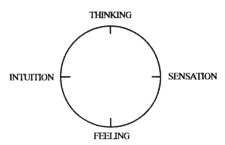
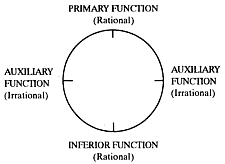
Jung's model of typology is the basis for modern type tests, such as the Myers-Briggs Type Indicator (MBTI) and the Singer-Loomis Personality Profile, used in organizational settings.
Unconscious. The totality of all psychic phenomena that lack the quality of consciousness. (See also collective unconscious and personal unconscious.)
The unconscious… is the source of the instinctual forces of the psyche and of the forms or categories that regulate them, namely the archetypes. [“The Structure of the Psyche,” CW 8, par. 342.]
Unconsciousness. A state of psychic functioning marked by lack of control over the instincts and identification with complexes.
Unconsciousness is the primal sin, evil itself, for the Logos.[“Psychological Aspects of the Mother Archetype,” ibid., par. 178.]
Wholeness. A state in which consciousness and the unconscious work together in harmony. (See also self.)
Although "wholeness" seems at first sight to be nothing but an abstract idea (like anima and animus), it is nevertheless empirical in so far as it is anticipated by the psyche in the form of spontaneous or autonomous symbols. These are the quaternity or mandala symbols, which occur not only in the dreams of modern people who have never heard of them, but are widely disseminated in the historical records of many peoples and many epochs. Their significance as symbols of unity and totality is amply confirmed by history as well as by empirical psychology.[“The Self,” ibid., par. 59.]
Will. The amount of psychic energy or libido at the disposal of consciousness, implying some control over instinct.
The will is a psychological phenomenon that owes its existence to culture and moral education, but is largely lacking in the primitive mentality.[“Definitions,” CW 6, par. 844.]
Wise old man. An archetypal image of meaning and wisdom. In Jung's terminology, the wise old man is a personification of the masculine spirit. In a man's psychology, the anima is related to the wise old man as daughter to father. In a woman, the wise old man is an aspect of the animus. The feminine equivalent in both men and women is the Great Mother.
* Extracts are, in the original, supported by extensive analysis and direct quotes from: The Collected Works of C.G. Jung. 20 vols. Bollingen Series XX, translated by R.F.C. Hull, edited by H. Read, M. Fordham, G. Adler, and Wm. McGuire. Princeton University Press, Princeton,1953-1979.
The names of the individual volumes are as follows:
1. Psychiatric Studies
2. Experimental Researches
3. The Psychogenesis of Mental Disease
4. Freud and Psychoanalysis
5. Symbols of Transformation
6. Psychological Types
7. Two Essays on Analytical Psychology
8. The Structure and Dynamics of the Psyche
9i. The Archetypes and the Collective Unconscious
9ii. Aion: Researches into the Phenomenology of the Self
10. Civilization in Transition
11. Psychology and Religion: West and East
12. Psychology and Alchemy
13. Alchemical Studies
14. Mysterium Coniunctionis
15. The Spirit in Man, Art, and Literature
16. The Practice of Psychotherapy
17. The Development of Personality
18. The Symbolic Life: Miscellaneous Writings
19. General Bibliography of Jung's Writings
20. General Index
C.G. Jung Letters. Bollingen Series XCV. 2 vols. Ed. Gerhard Adler and Aniela Jaffé.Trans.R.F.C.Hull. Princeton University Press, Princeton, 1973.
Memories, Dreams, Reflections. Ed. Aniela Jaffé. Pantheon Books, New York, 1961.
The Freud/Jung Letters. Bollingen Series XCIV. Ed. William McGuire. Trans. Ralph Manheim and R.F.C. Hull. Princeton University Press, Princeton, 1974.
Nietzsche's Zarathustra: Notes of the Seminar Given in 1934-1939. Bollingen Series XCIX. 2 vols. Ed. James L. Jarrett. Princeton Univer-sity Press, 1988.
The Competitiveness of Nations
in a Global Knowledge-Based Economy
October 2002